
Technology & Support
Technical support system

DCTs use a variety of digital tools to facilitate at-home data collection, enhance participant convenience, and enable remote monitoring. However, the use of multiple tools—often sourced from different vendors—can create challenges for both participants and support teams. It was recognized that site staff and CRAs may not have the technical expertise to resolve complex issues independently, even after consulting a knowledge base (KB). This underscores the need for robust sponsor-provided support structures, including a centralized support team that is equipped to manage both site- and participant-facing problems, thereby reducing site burden and coordinating support requests effectively.
Recommendations
How Trials@Home reached these recommendations
These recommendations are based on operational experience from RADIAL, intentionally integrating only components where operational or regulatory value justified the effort. RADIAL’s support system focused on issue resolution through a centralized technical support system, featuring a structured ticketing tool and process, and a multilingual KB with training materials and FAQs. This system served as a core operational layer, supporting site staff and CRAs across all study arms through routed support requests. While training content was included, the system itself did not handle site readiness or conduct training activities. Figure 1 illustrates the key components of RADIAL’s support system.
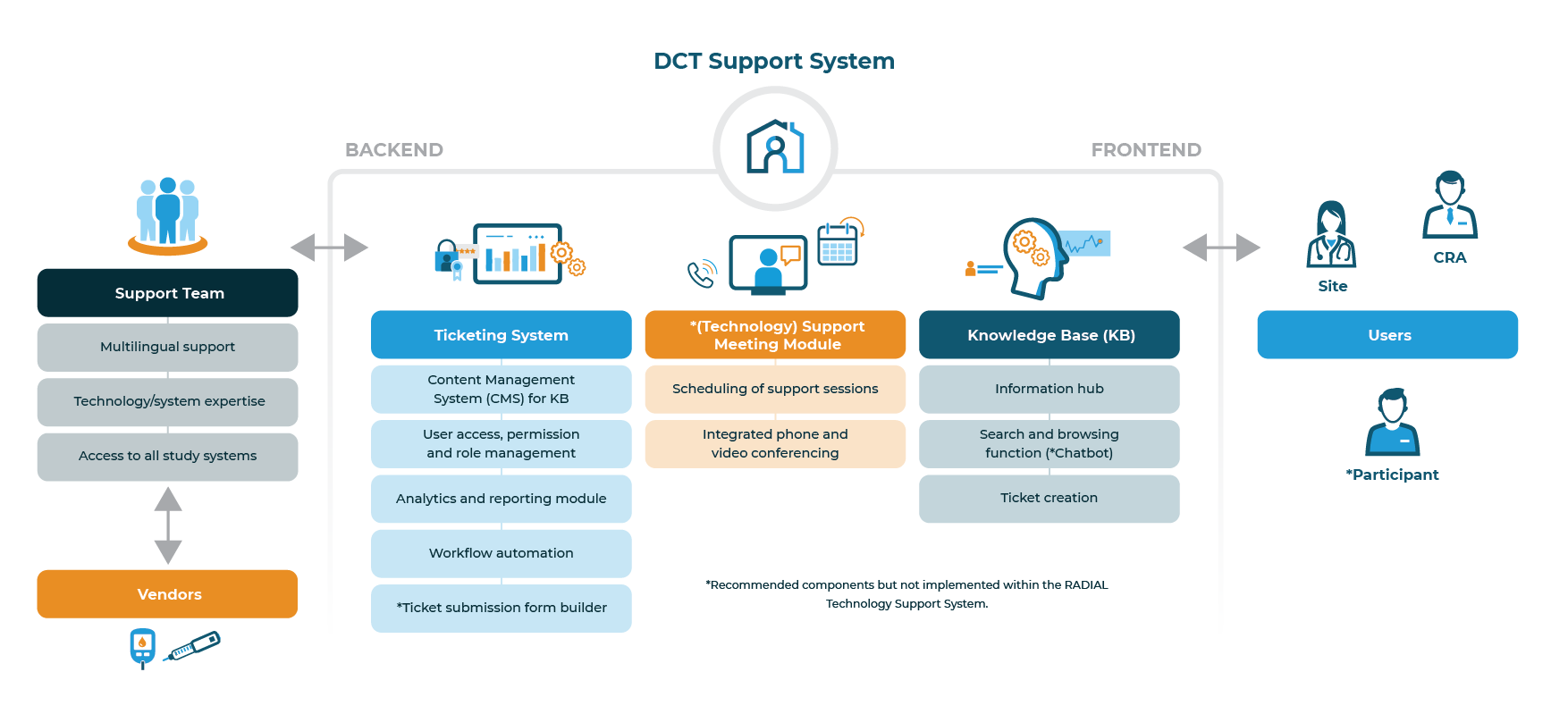
Implemented technology support system components along with recommended additional modules based on the experiences with RADIAL.
Ticket data, issue trends, and usage patterns were continuously reviewed in governance meetings involving both technical and operational representatives. While the platform itself did not offer built-in live support, the helpdesk aimed to respond to tickets within 24 hours. In more complex cases, live or video calls were proactively arranged—often in users’ native language. Ongoing evaluation of support interactions highlighted the importance and need for early support team involvement, intuitive tools, and flexible assistance approaches to effectively address user-facing challenges. Qualitative interviews with sites were conducted to gather experiences and recommendations for the use of a helpdesk in DCTs.
Further reading

Publications
Operationalising Decentralised Clinical Trials: Technology Insights from the Trials@Home RADIAL Proof-of-Concept Trial.
Hanke, et al |
Clinical Pharmacology & Therapeutics |
2025 |
|---|
Technology Support System and Review Process for a Decentralized Clinical Trial: Trials@Home, RADIAL DCT as Case Study.
Hanke, et al |
International Joint Conference on Biomedical Engineering Systems and Technologies |
2024 |
|---|
Toward Effective Technology Support in DCTs: Insights from the Trials@Home Proof-of-Concept Trial RADIAL
Weitlaner, et al |
Journal of Medical Systems |
2026 |
|---|

Deliverables
An interconnected, fully tested technology platform that connects the technological solutions chosen for the technology package and supports the WP3 pan-EU Pilot.
WP TECH, 2023 |
|---|
Technology support system
WP TECH, 2023 |
|---|
Updated summary and detailed report with recommendations for integrated technologies to be used in DCT and hybrid approaches, based on pilot findings
WP TECH, 2025 |
|---|